Fresh Brews: Lungo3D, TinyVideo, and ScanStraightener Join the Menu
Three apps left the Coming Soon board this week: a real 3D CAD tool, a video compressor that never uploads, and a doc scanner that lives on your Mac.
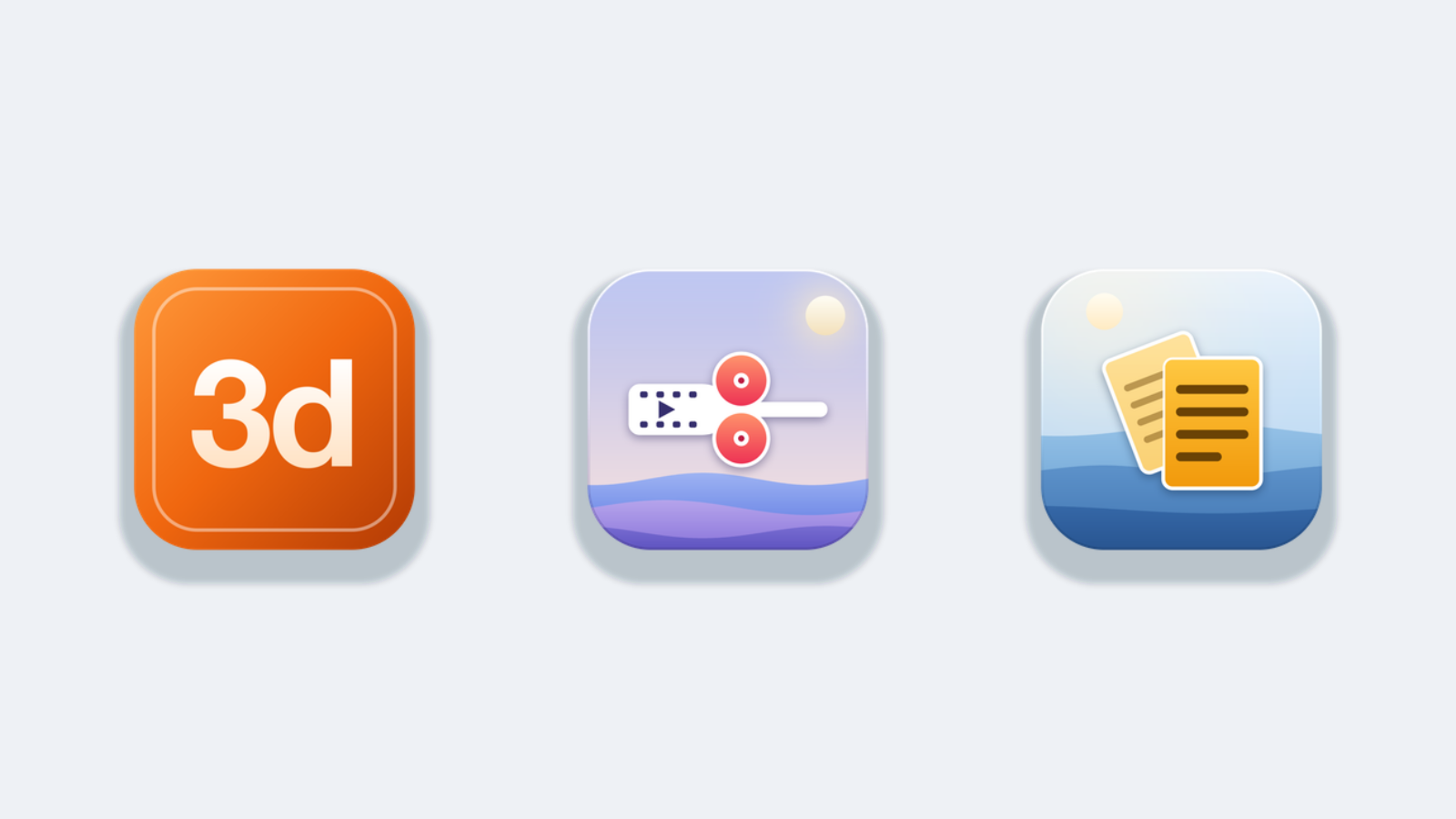
Three apps moved off the Coming Soon board this week. A 3D CAD tool joined Mocha, a video compressor landed in Americano, and Latte's scan family got its first live member. Here's what each one does and who it's for.
Lungo3D opens the CAD files engineers actually send

Most Mac users meet STEP and IGES files the way you meet a PDF you can't open: someone emails one over and you stare at it. Lungo3D actually opens those files and lets you work with them. You get the real solid model on a real geometry kernel, ready to measure, cut, fillet and export.
It runs entirely on your Mac. No account, no upload, no browser tab. That matters more for CAD than for almost anything else, because a drawing of a part someone is about to manufacture is usually the most confidential file in the room. A client's model should not take a detour through a web service just so you can look at it.
The kernel is Open CASCADE, the same geometry engine behind serious CAD packages, so a curve stays a curve and fillets behave the way they did in the file's home program. Around sixty modelling commands ship in the box: sketch, extrude, revolve, loft, sweep, boolean cuts, chamfers. You can measure length, angle, area and volume in the unit you want, snap to endpoints and midpoints and tangents, and walk the document tree to see how the model was built. Export goes back to STEP, IGES or BREP, or out to STL, OBJ and PLY for 3D printing.
Lungo3D is $21.99 once, or included in the subscription. It's the priciest single item on the menu, which is fitting for the only one that replaces a seat of professional CAD. The source is AGPL-3.0, built on the open Chili3D kernel.
TinyVideo makes video smaller without sending it anywhere

Screen recordings, phone clips, exports for clients. Most of them are bigger than they need to be, and the usual fix is a web service with a queue and an upload bar. TinyVideo skips the queue: you drop clips on the window and a compressed copy lands next to each original, encoded by your own Mac.
The defaults are sensibly boring. Same codec, same container, same resolution unless you say otherwise. A 4K clip stays 4K, an MKV stays an MKV. If you want the change, Settings can convert to H.264 or HEVC and cap the longest edge. Three squeeze levels, Smaller, Balanced and Best, replace the wall of encoder settings you would otherwise have to learn.
Two details make it feel carefully built. It never hands you a larger result: if a clip was already compressed hard and a re-encode would grow, TinyVideo keeps the original bytes and tells you. The progress rows show real percentages as the encoder works, not a spinner. Drop fifty clips and they run one after another, so the first result lands while the rest are still going.
It drives ffmpeg and walks you through installing that once, one command copied to your clipboard. Bundling ffmpeg would have turned a 6 MB download into a 200 MB one, so it uses the copy on your machine. TinyVideo is $9.99 once, or included in the subscription.
ScanStraightener turns desk photos into scans

A photo of a document comes with perspective, uneven light, and usually a mug in the background. ScanStraightener closes most of that gap: drop in a photo of a contract, a receipt or a page of notes, and you get back a square, evenly lit JPG, the page as a scanner would have caught it.
Page detection and perspective correction run through Apple's Vision framework on your Mac. Nothing gets uploaded, which is the whole point for a payslip, a passport photo or a medical letter. Your originals are never touched. Every scan is written as a new copy beside the photo it came from, with a suffix you choose.
You get four looks, one click apart: keep the photo as it was, clean it up like a scanner would, drop to gray, or go hard black and white for the smallest sharpest text. A page photographed sideways is read four ways round and saved the right way up. Drop twenty photos and they queue, several at a time, each landing beside its own original. When the batch is done, one button binds every finished page into a single PDF, one page per scan, each page keeping its real physical size.
ScanStraightener is $14.99 once, or included in the subscription. It's the anchor of Latte's scan family: ScanToPDF, for a PDF whose text you can select and search, and ScanToDocx, for an editable Word file, are still on the Coming Soon board. If you want to crop or retouch a finished page, it opens in Pixpresso in one click.
The rest of the waitlist
That leaves three apps coming: ScanToPDF and ScanToDocx in Latte, and VectorStudio in Mocha. The menu now serves 68 apps, 63 of them paid. Buying those 63 one at a time adds up to $767; on a subscription it's $671 less in your first year, or about $1.60 per device per month on Family Roast.
All three got their first mention in earlier Fresh Brews posts: Lungo3D in the MergeImages and MapPoster roundup, TinyVideo and ScanStraightener in the CremaStudio price-cut post. Good to see them off the waitlist.
All three new arrivals work offline by default. If that's the direction you like your software going, the whole menu is a 7-day free trial away, no credit card required (#pricing).