Portfocino: Stocks, Crypto and Property in One Encrypted File
Portfocino tracks 16 asset classes and 4 kinds of debt in one encrypted file on your own disk. Prices for stocks, funds, crypto and bullion arrive when you press the button, never on a timer, and strict money rules stop a failed refresh from quietly lying to you about what you are worth.
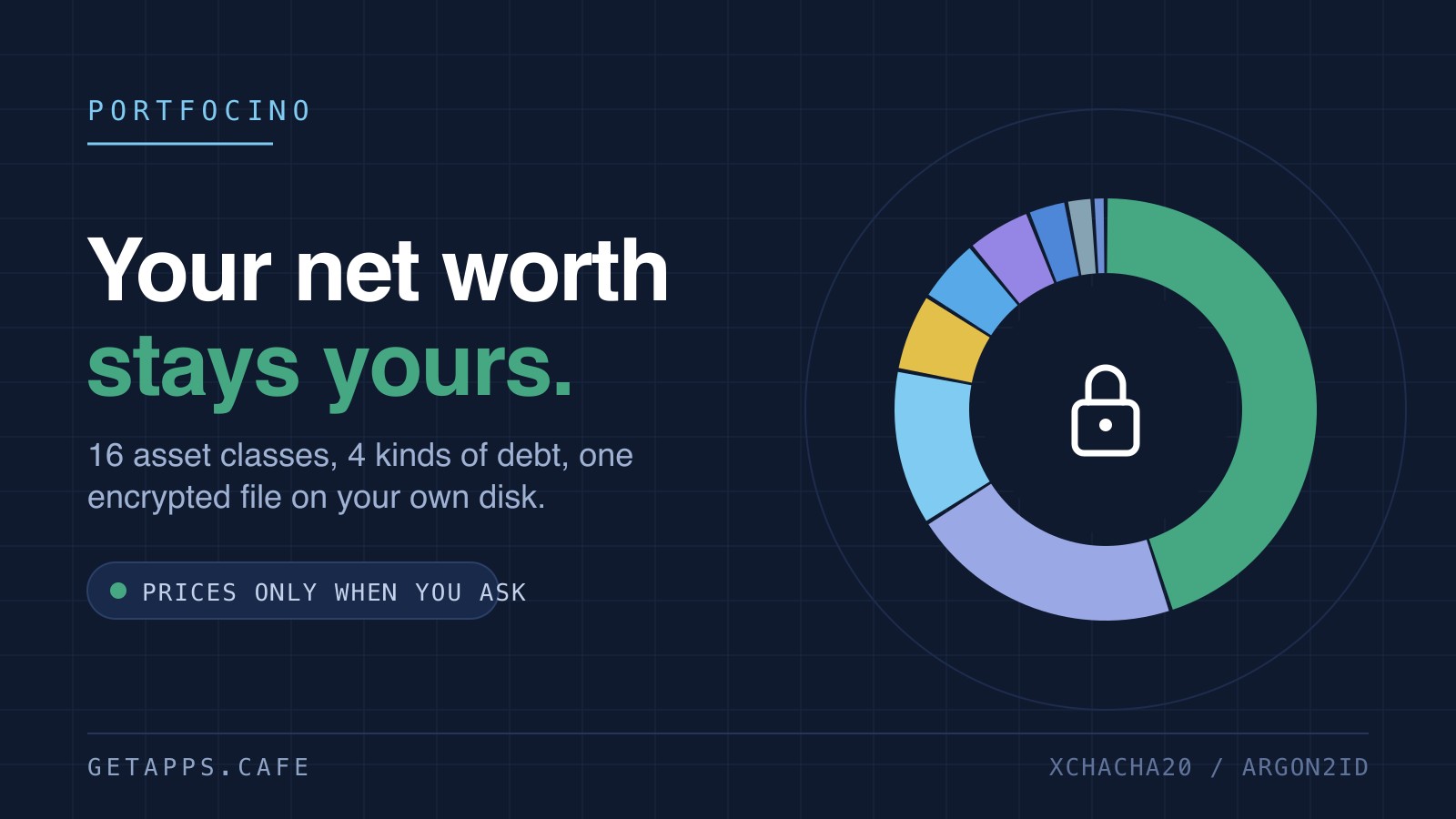
You know your salary and you know your mortgage. Everything else is probably a guess. Portfocino is the app that stops the guessing, and it does the math without asking you to hand your financial life to a server.
One Ring, And the Number in the Middle
The app belongs to the Affogato category, and it tracks your net worth using one allocation ring. Every asset class is a slice. The total sits in the middle, alongside the change since your last snapshot. The app calculates that number using a numeric core written in Rust, handing one computed summary to the rest of the interface. The ring, the sidebar, the stat tiles and the table all render from that same data. They cannot disagree with each other.
Every save records a real snapshot of that day. The history line measures against those hard saves. It never estimates. A period with no old-enough snapshot simply reports nothing rather than borrowing a nearer one, because the app refuses to interpolate its own history. You can keep several portfolios open at once, each in its own window, each saving to its own file. Because class names and currency codes are stored as internal identifiers rather than labels, a file written in one language opens correctly in any of the other twelve, including Spanish, Japanese and Indonesian.

Sixteen Kinds of Asset, Four Kinds of Debt
Money takes different shapes. The app tracks sixteen asset classes: cash and bank accounts, term deposits, stocks and equities, ETFs and mutual funds, bonds and fixed income, cryptocurrency, real estate, gold and precious metals, commodities, retirement and pension, private and startup equity, collectibles and art, vehicles, loans receivable, insurance and annuities, and other assets.
Then there are the four liability classes. Mortgages, loans, credit cards and other liabilities. Debt subtracts. The number resting in the centre of the ring is a true net figure.
Every class has its own form. There is no generic row that asks you to jam a flat into a stock ticker field. The forms ask for exactly what that kind of holding needs. Only four of the sixteen asset classes carry a fetched market price: stocks, funds, crypto and precious metals. You enter and maintain the rest yourself.

Prices Arrive When You Press the Button
There is one button, labelled Update prices. Press it, and Portfocino fetches current quotes for your stocks, funds, coins and bullion.
Nothing polls.
There is no timer, no background refresh, and no hidden sync daemon. The app reaches out to the network when you click the button and at no other moment. It pulls from three sources that require no API key or account: CNBC for stocks, funds and metals, CoinGecko for cryptocurrency, and an open service for exchange rates. You can also type an exchange rate in by hand. 137 automated tests cover the engine, the file container, and the separate parse functions that read each provider's wire format without a network connection.
Pressing that button does send your ticker symbols and coin names to those three services. It does not send quantities, it does not send your net worth, and it never sends a personal identifier. Outside that one button, the app makes no network requests at all.
A financial tracker is dangerous if a silent failure looks like a real number. Portfocino applies strict money rules so a refresh cannot lie to you. A holding in a currency with a missing exchange rate is excluded from the total and flagged with a visible warning. It is never quietly converted at one-to-one. A priced holding with no price contributes nothing. It is never silently counted as zero. If a symbol fails during a fetch, the refresh does not wipe the price. The failure is reported, and the last known price and its timestamp stay exactly where they were.
If a quote comes back in a different currency from the holding, it is reported and rejected. The app scales London prices automatically, converting pence to pounds so your holding is not a hundred times out. It does the same for South African and Israeli minor units.
A House Is Not One Number
The real estate form asks for the address, property type, floor and land area, bedrooms, year built, ownership and title, purchase, valuation and income. Ownership share is a percentage. A half-owned flat scales the valuation and purchase price, counting as half. You can link a mortgage to the property securing it. You can attach photos, a deed, or a receipt, keeping the record and its proof encrypted together.

The Password Has No Back Door
Your portfolio is one self-contained file. Put it on a drive, drop it in a backup, or move it to another computer. There is no bank to connect and nothing is uploaded.
Typing a password on that file encrypts every holding, figure and attached photo inside it. The app uses the XChaCha20-Poly1305 cipher, stretching your password with Argon2id configured to demand 64 MiB of memory for each attempt. That memory requirement makes guessing passwords in bulk expensive rather than cheap. Those settings live inside the file, ready to be made stronger in the future without breaking what you write today.
Removing or changing a password is instant, even on a file holding hundreds of megabytes of photos, because it rewrites a tiny header instead of re-encrypting the data. That plaintext header carries only what a stranger is allowed to see: the file name, its currency, when it last changed, and how many holdings it has. It never leaks a value or a holding name, letting your recent files list show useful rows safely. A locked portfolio renders nothing and yields nothing.
If you use a Mac, Touch ID can open the portfolio instead of typing the password. Windows has no equivalent in this app. Leaving the password blank entirely is a real choice with a real consequence: anyone with a copy of the file can read it.
There is no back door. The password cannot be reset or recovered by anyone, including us. This is a warning as much as a feature.

What It Will Not Do
Only stocks, funds, crypto and precious metals get fetched prices. Property, vehicles, collectibles, private equity and the rest are values you enter and keep up to date yourself. There is no bank connection and no automatic import. You enter your holdings by hand.
Nothing updates in the background. If you do not press the button, the prices are the prices from last time, and the interface tells you exactly when each was taken.
Touch ID unlock is macOS only.
A forgotten password means the file is gone. There is no recovery.
Those limits are the exact same decision as the privacy. The app does not reach for your data because it does not need to, keeping your numbers in a quiet, encrypted file you can set up through a getapps.cafe membership.